Tampilkan postingan dengan label privilege. Tampilkan semua postingan

Kamis, 09 Februari 2012

Good News: Unemployment Among Black Men Drops

Shani O. Hilton at Colorlines:
When the Labor Department released the January unemployment rate last week, there was finally some good news to celebrate—and some news that seemed almost too good to be true. Black unemployment saw its steepest drop since the recession began, dipping more than two points. Apparently, that happy improvement was largely driven by black men being hired in larger numbers than anyone can remember.

So what, exactly, is happening here? Nobody saw it coming, and there's no immediate explanation. I talked to Algernon Austin, director of the Race, Ethnicity, and the Economy program at the Economic Policy Institute, to get some insight.

Colorlines: So, the interesting thing about January's unemployment rate was that the unemployment rate for black men dropped 3 percent—from 15.7 percent to 12.7 percent—even though workforce participation stayed about the same. That's not something we've seen before, is it?

Algernon Austin: Such a large drop in the unemployment rate is quite surprising. Certainly, we haven't seen a drop that large any time recently. There was a slight decline in workforce participation, but even looking at that, we're talking about a very large decline for blacks, and particularly black men, which is quite unusual.

What are the fields—or are there any—where it's more likely that black men were hired?

It's a real mystery to figure out what might be going on here. The public sector dropped jobs, so that's not likely to be it. Restaurants and bars—that's not likely. Retail, maybe some retail; maybe some health care. Maybe temporary health services, construction. But really, I don't know.
It is not just a coincidence that, during the first bit of job growth we've had since Barack Obama was elected, black men are "being hired in larger numbers than anyone can remember." It is evidence of the known effects of visible diversity.

To think that seeing a black man in the news, competently running the most powerful nation on the planet, day after day for three years, hasn't worked on the subconscious of US employers, hasn't sent a message that gets internalized in the same way the narratives of exclusion and marginalization and less than do, is to imagine that humans work in a way that we actually don't.

That is not the only explanation for this good news. There are certainly other influences, which Algernon Austin and his team will suss out at the invaluable EPI.

But I wanted to note nonetheless: This is no coincidence. This is the value of meaningful inclusion.

Selasa, 31 Januari 2012

Today in Kyriarchetypes

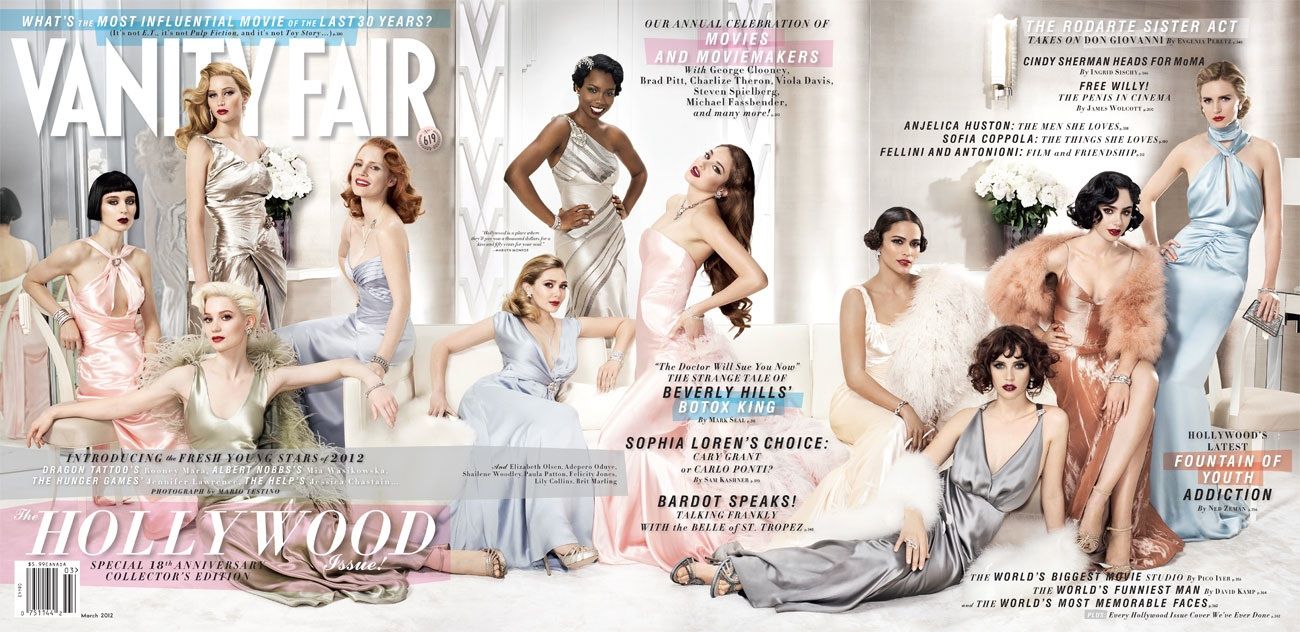
In case you'd forgotten (ha ha how could you even if you wanted to?), Hollywood is steeped in white privilege. And thin privilege. Also sexual objectification. And Photoshop. Plus other things that are in various ways Not Good!

The cover of Vanity Fair's 2012 Hollywood issue:

the cover of Vanity Fair's 2012 Hollywood Cover, featuring almost exclusively thin white women
[Click to embiggen.]

I will just quickly note, once again, in spite of its being an unceasingly vomitous font of racism, sexism, homophobia, transphobia, ageism, ablism, fat hatred, rape jokes, violence, bullying, and other sundry bigotries and hostilities, Hollywood (meaning the entertainment industry, not the town) is nonetheless yet regarded as a bastion of liberalism.

It's funny how much "Hollywood liberal elitism" looks like an Ayn Rand wank-fantasy.

Jumat, 20 Januari 2012

I Write Letters

Dear Parks & Recreation:

I recently wrote you a letter telling you how much I love you. And I feel like it may have been insufficient. Because I love you A LOT.

Also: I loved last night's episode (for which there are spoilers that follow, if anyone else happens to be reading this letter I'm definitely writing to a television show), and I want to tell you: I see what you did there.

Like, first of all, the episode was about Leslie Knope meeting her opponent in the city council election, and I'll come back to that in a second, but there was this great sub-plot with Andy and April about Andy hurting his head (repeatedly) and needing medical care. Now, it was obviously great because it was hilarious, but it was also great because it was this sneaky commentary on our healthcare system and how totally fucked up it is for everyone who isn't a bazillionaire, because surprise! Deductibles.

Every part of it was perfect: Can't afford healthcare with no insurance. Finally have insurance? Get EVERYTHING fixed! Before you don't have health insurance anymore! Wait? Insurance doesn't cover everything? OH SHIT. This system is so terrible. It is the worst!

Seriously, it was sooooooo great.

But ALSO! The main arc about Leslie meeting her opponent, Bobby Newport (Paul Rudd, such perfect casting), was the best! I see what you did there, too, with your sneaky commentary about class privilege and male privilege! And instead of making Bobby Newport some sort of evil caricature, you went all meta in an episode about Leslie not wanting to negatively campaign and made her opponent nice—just ALSO a super-privileged and super-spoiled dude whose entitlement actually makes him weak.

And THEN! Then comes the best part of all, where Leslie's principled stance against negative campaigning forces Ben to devise a campaign ad that is basically the greatest thing ever, not just because it underlines what it takes for marginalized people to close the gap created by the headstart that privilege confers, but because it centers as important the big dreams of little girls, which shouldn't make me blub so much, but does, because it's so rare, so goddamn rare, to see that on a television show, or anywhere, without those dreams being the butt of someone's joke. I love this so hard:

Video of young Leslie Knope sitting at a desk in her bedroom, labeled 1985. Behind her is a hand-written sign reading "Vote Knope." Ben says in voiceover: "This is city council candidate Leslie Knope when she was ten years old." Young Leslie says: "Hi, I'm Leslie Knope. I love Pawnee, and I want to make it even better—better schools, safer streets, and a more progressive tax on residential properties."

Over text onscreen reading "Bobby Newport, 2012," Ben says in voiceover: "This is city council candidate Bobby Newport today." Bobby, on a video, with a farm clearly green-screened behind him: "People keep asking me, 'Bobby, what are you gonna do once you get into office?' Um, I'm pretty sure I'll figure it out."

Ben, in voiceover: "Leslie Knope had better ideas when she was ten than Bobby Newport has now. They do have one thing in common—" Split-screen of Leslie with a stuffed toy dog and Bobby with his Afghan hound, both of them saying, "I like dogs!" Ben continues, over an image of her campaign logo: "For a better Pawnee, vote Knope for city council."
She's been thinking about the job since she was ten. Bobby Newport's doing it on a whim to get his dad off his back. I see what you did there, Parks & Recreation. I see what you did there.

And I like it. I like you.

Thanks. Keep up the good work!

Love,
Liss

P.S.
image of Rashida Jones
Ann, you are so beautiful and so smart.

Kamis, 05 Januari 2012

Both Sides Are Blah Blah Yawn

by Shaker TC

[Comment Note: This post contains discussion of anti-choice narratives and violence.]

I have mixed feelings about the public radio show "This American Life," but a segment in their Nemeses episode on the abortion debate in Boston made me nauseated to the core of my being. (The transcript is here; bring a barf bag.) "This American Life" decides to double down on the Jon Stewart-eqsue "both sides do it" meme for the abortion debate. Ira Glass is oozing with unacknowledged privilege as he talks about the attempt for the two sides of the debate to find common ground. The frame of the entire piece is that both sides of the debate are equally responsible for the dynamic.

Here's the kicker for me: This "both sides do it" frame is in the context of an abortion clinic shooting.

Along with Ira Glass, the host of "This American Life," the key commentator on the issue is white male academic Peter Coleman from the International Center for Cooperation and Conflict Resolution at Columbia University.
Peter Coleman: I think the pro-life movement was ashamed and infuriated by what had happened. I think the pro-choice movement was terrified and traumatized. And so the governor, the archdiocese, called for dialogue.
Notice that the people directly affected by the shooting weren't calling for dialogue with a movement with which the killers identified and were affiliated. But they were nonetheless obliged to participate in unwanted bridge-building to make the patriarchy feel better.

Naturally that bridge had to be built on the backs of women. All of the folks involved in the dialogue were women—on both sides of the debate. According to ivory tower academic Coleman, one of the two men discussing this enforced dialogue between women, the worst thing that could happen is blame and responsibility, because that's for mean harpies.
Peter Coleman: At first, the conversation was hard. Even though they agreed to some guidelines and how to have this conversation in a way that they felt would be constructive, it was hard to hold to those guidelines initially.

Ira Glass: And you write about that, that there was a lot of finger pointing back and forth. Everybody thought, we're not going to do any finger pointing. But in fact, they couldn't help themselves is what you write.

Peter Coleman: It's what they did. It's what they had been doing. They were used to doing it. They knew the talking points. And it was so hard to try to put those away.
So, the abortion rights supporters, whose community is being terrorized, are disallowed from feeling that members of a movement with which a terrorist was involved could or should be held accountable. That's just finger-pointing.

Then Ira Glass decides to play clueless person of privilege by framing the whole thing as a silly conflict that people were irrationally holding onto—as if there weren't VALID REASONS for animosity toward anti-choice proponents like, I don't know, people who shoot people associated with abortion clinics.
Ira Glass: These are precisely the conflicts that Peter Coleman studies. They're the conflicts where whatever the original dispute happened to be about, everybody has moved past that long ago. And things have snowballed. And people started to organize their identities around the conflict.
As an abortion rights activist, I know damn well what I'm fighting for. It's not some long-held grudge. It's the bodily autonomy of women. Refer to any one of Melissa's awesome posts on Jon Stewart on why this attitude of "stop the bickering" when it comes to issues of human rights is so nauseating. If Ira Glass believes that the issue of abortion rights is based on some petty grudge that everyone has moved past, he has the empathy of a rock.
And then comes the mother of all victim-blaming.
Peter Coleman: Because what did happen is that the rhetoric changed. The conversations that would happen publicly around abortion, around pro-life, pro-choice, lost a lot of the edge and the vitriol in the community that it had had prior to the shooting and prior to the dialogue process.

Ira Glass: Because these women were leaders in those movements on both sides and—

Peter Coleman: They consciously decided that part of what they had done is contribute to the conditions where an event like this could take place.
Yep, apparently, abortion rights folks share responsibility for an anti-abortion shooter coming into their offices. The pro-choice advocates had to do some real soul-searching to see how they contributed to a shooting happening in their clinic to their clients, I'm sure.

There's a whole lot o' privilege playing out in this entire piece, from the unacknowledged point that the people pushing for dialogue were patriarchal institutions, to Ira Glass' characterizing an issue of the bodily autonomy of half the population as something people have "moved past," to the piece saying that both sides saw they had a role in the shooting. Poor Ira Glass, his only wish is that the layDEEEZ play nice.

This was completely nauseating and further proof that the "liberal" public radio is pretty damn unfriendly to progressive women.

Kamis, 22 Desember 2011

This is so the worst thing you're going to read all day.

[Trigger warning for fat hatred, body policing, and bullying.]

BBC: Tell loved ones they are overweight this Christmas.

LOL FOREVER! Yes, please do that. Please everyone tell me that I am fat this Christmas, because I DON'T KNOW. There is no gift like the gift of treating me like I am totally fucking stupid.

(Btw, you'd think a vast international news organization like the BBC might have heard the news that not everyone celebrates Christmas, but APPARENTLY NOT.)

Leaving aside all the myriad problems with this approach—that it's heinously cruel, that shaming doesn't work even if it weren't heinously cruel, that one cannot know another person's health simply by looking at them, that it presumes gluttony and ignores systemic and all other individual causes of fat, including disability and disease—I just want to quickly note that the narrative of every story like this one is that not-fat people should assume their fat friends and family members are all psychologically damaged wrecks who need someone to tell them to care about themselves.

Now, some fat people are indeed fat as the result of disordered eating resulting from emotional trauma of one description or another, but that is not a safe or fair or reasonable conclusion to axiomatically draw about anyone.

And, further, if a fat person is indeed fat as the result of disordered eating, the last goddamn thing they need to hear is how fat they are and why don't they take care of themselves and blah blah blah, especially from the people who may very well be the source of emotional eating in the first place.

I will never stop being amazed by how we are encouraged to regard all fatties as people overeating to fill an emotional void, then interact with them in abusive ways that create emotional voids.

If I were concerned that another fatty whom I love was eating to fill a void, I would seek to fill that void full up with love, not deepen it with sanctimonious codswallop. Fuck.

[H/T to Shaker Emily.]

Selasa, 20 Desember 2011

This is so the worst thing you're going to read all day.

Bloomberg: Bankers Seek to Debunk Attack on Top 1%.

Everything about this article is perfectly hilaritragic. I especially looooooove the insistence that the richest people in the country are rich exclusively because of hard work and perseverance. "Instead of an attack on the 1%, let's call it an attack on the very productive." Ha ha sure. Let's do that, fucko.

But first, let's you and I see which one of us works harder in a day. Let's see if you or the last waitress who served you works harder in a day. Let's see if you or any one of the hundreds of people in service jobs with whom you come into contact on a daily basis whose humanity you don't even notice, no less acknowledge, works harder in a day. Let's see if you or a homeless person just trying to stay warm, fed, and alive works harder in a day.

Let's do that math, and then let's indeed call the increasing divide between the haves and the have-nots in this richest country in the world "an attack on the very productive."

Productivity isn't the issue. The kind of work we choose to value and the people whom we choose to do that value is.

Senin, 19 Desember 2011

Whoops

You know what would have made this piece about "Nerds and Male Privilege" better...? If its male author had linked to any one of the hundreds (thousands?) of female writers who have said the very same thing before.

It's not that I don't appreciate the effort and all that, cookies for everyone, but when the central idea of one's thesis is "A man can expect to have his opinion considered, not dismissed out of hand because of his sex," if one doesn't want to more deeply entrench that marginalizing dynamic, one would do well to acknowledge any of the many, many, many women who share his opinion and have, in fact, been disregarded.

Just a suggestion.

[H/T to Iain.]